Nobody prepares you for the exact second the world splits in two.
One moment, you are arguing about what to make for dinner, or laughing at a text message they sent an hour ago. The next, you are standing in a sterile, fluorescent-lit corridor, watching your person — the anchor of your family, the one who taught you how to stand, the partner who knows every story about your past — transfer into a wheelchair.
Just like that, they have a wristband. They have a chart. They have become a patient.
And you have become something else entirely.
If you are sitting in a waiting room right now, staring at a paper cup of lukewarm coffee, or staring blankly at the ceiling in a dark bedroom at 3 a.m. wondering how you got here, this is for you.
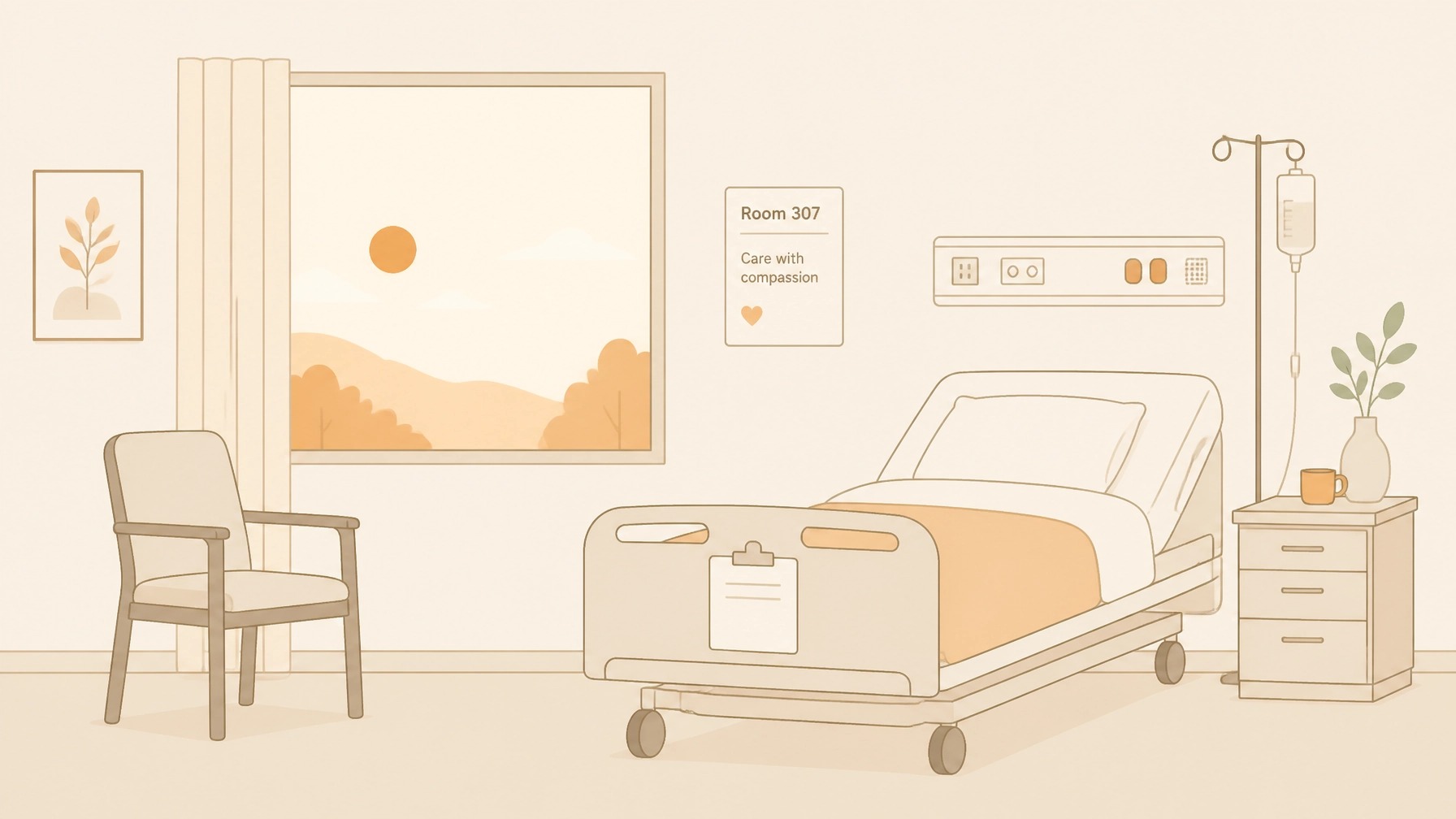
There is a distinct kind of shock that hits you the first time you walk into their hospital room after they've been admitted. The bed is too high. The pillows are too thin. The gown is open in the back, exposing shoulders that have always felt unbreakable to you. They look smaller.
It hits you behind the eyes first. A sharp, burning pressure. You swallow hard, force a bright smile onto your face, and walk through the door saying something cheerful like, "Hey! How are we feeling?" Because that's your job now. You are the designated optimist. You are the shield.
Inside, a quiet panic is screaming. That is my mother. That is my husband. That is my rock. Seeing someone you love reduced to a room number, a diagnosis code, and a series of vital signs is an emotional violation you can't train for. No one warns you about the vertigo of it. One day they are taking care of the world; the next, they can't get out of bed to brush their teeth without a team of strangers assisting them.

Let's talk about the guilt. Not the polite, surface-level guilt, but the dark, ugly kind that settles in the pit of your stomach when you think no one is looking. The guilt of walking down to the cafeteria to buy a sandwich because you are starving, while they lie upstairs unable to eat. The flash of resentment when a nurse walks in to check vitals right as you finally managed to close your eyes for twenty minutes. The sudden, irrational anger at the person you love more than life itself — for getting sick, for disrupting the universe, for making you carry this terrifying weight.
Stop beating yourself up for those thoughts.
You are exhausted. Your nervous system is redlining. Your brain is trying to process fifty medical updates an hour while grieving the version of your life that existed forty-eight hours ago. Feeling angry, resentful, or numb does not make you a bad daughter, a failing spouse, or an ungrateful friend. It makes you human.
You are allowed to be tired. You are allowed to hate this room, this hospital, this disease. You can love someone with every fiber of your being and still wish, just for a fleeting second, that you could walk out the front doors and drive away. Admitting that doesn't make you weak. It makes you honest.

If you are caring for a parent, there is a very specific kind of grief that comes with watching them age or decline overnight. For your entire life, they were the fortress. They made the decisions. They fixed the broken things. Now you are cutting their food. You are asking the doctor questions they are too tired or confused to ask. You are helping them shuffle to the bathroom, shielding their dignity with a towel and quiet words of encouragement.
Watching a parent become a child in front of your eyes is a slow, agonizing unraveling. You catch yourself grieving people who are still sitting right in front of you. You miss the person who could tell you what to do when things went wrong. Now, when things go wrong, you are the one everyone looks to. And it is terrifying.
A hospital room is never truly quiet. There are machines beeping. Nurses walking in at all hours. Doctors rattling off percentages, prognoses, and treatment plans in a language that sounds like Latin. Family members texting you every ten minutes asking for updates.
And yet, you have never felt so profoundly alone.
You realize, with a sinking heart, that while everyone cares deeply, you are the one who has to hold the whole picture. You are the one carrying the mental load of every shift change, every medication change, and every unspoken fear. When you get home at night — if you even get to go home — the silence is deafening. You look at their empty side of the bed, or their shoes by the door, and the reality crashes over you with the force of a tidal wave.
It's okay if you don't have an inspirational quote for this moment. It's okay if you don't find a silver lining. Some days are just dark, heavy, and hard.

Look at your hands. They might be shaking. They might be stained with hospital cafeteria ink or cold coffee rings. But they are holding things together. You didn't ask for this role. You didn't audition for the part of the family advocate, the bedside nurse, or the emotional shock absorber. You were simply thrust onto the stage because someone you love needed you. And you showed up.
You might not feel brave. You might feel like you are failing every single minute of the day. But staying in that room, holding their hand when you're terrified, and asking the hard questions when your voice is cracking — that is the very definition of love in action.
Take a breath. Drop your shoulders away from your ears. You don't have to fix the entire future tonight. You just have to get through this hour.
You are doing the impossible. And you are not alone in the dark.
— Nazlyn
We talk a lot about the practical survival tools here — what to pack in your go-bag, how to navigate the frantic first 72 hours, how to organize the chaos. But underneath all the checklists, there is this raw, pulsing human heart trying to stay afloat in unfamiliar waters. If that's where you are tonight, the 3:19 Project exists for exactly this.